 English
 русский
Oct 05,2026
Content
Learning airbrushing is a skill that's "easy to start, but requires some effort to master." Unlike traditional brushes or pens that directly contact the surface, it's more like a technique of manipulating "colored wind."
Here are some practical aspects regarding the difficulty of learning airbrushing:
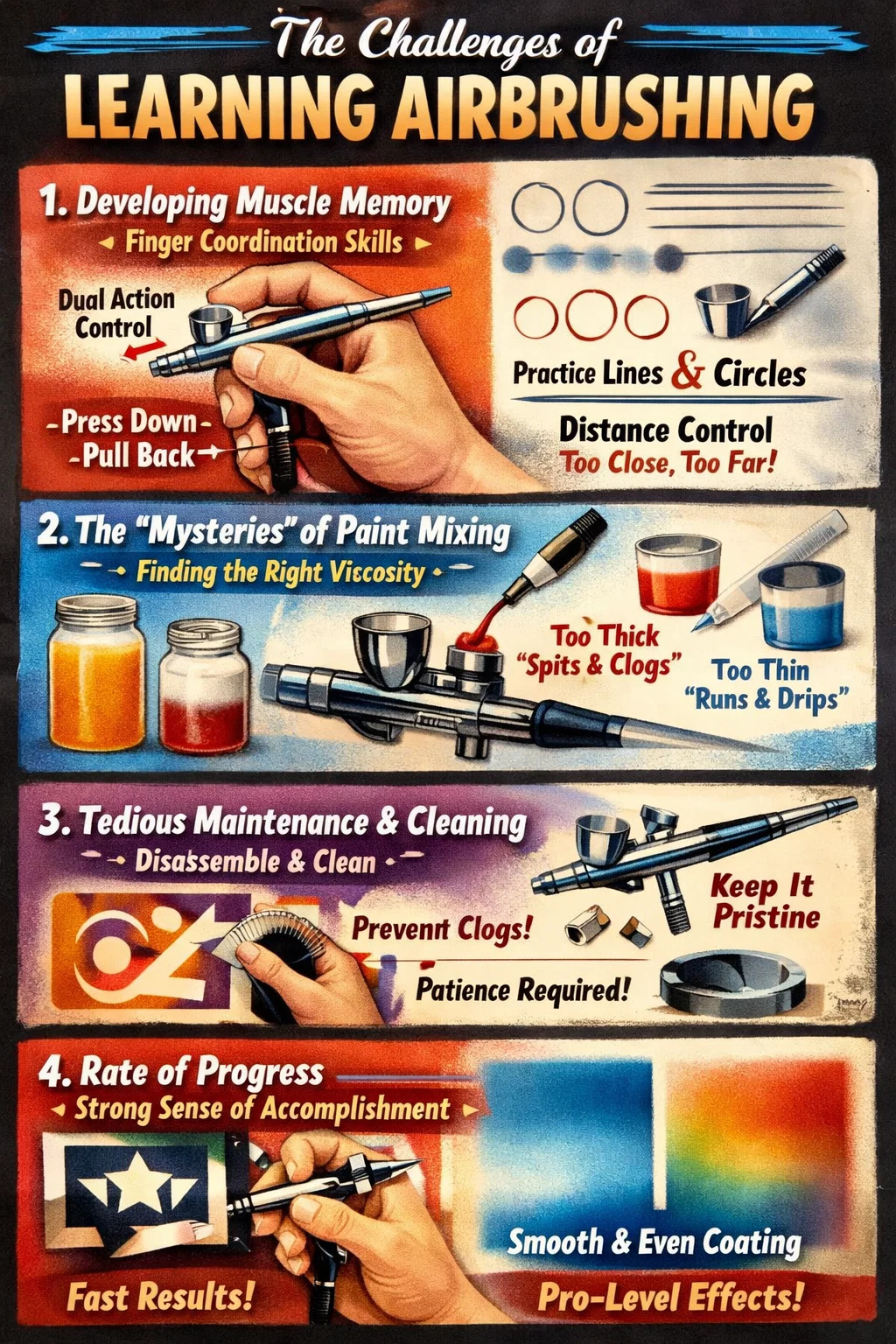
1. Developing Muscle Memory (Finger Coordination)
This is the first small hurdle for beginners.
Dual-action operation: Most beginners initially find the simultaneous "pressing down" and "pulling back" motions a bit awkward. It's like learning to use the clutch when driving; it takes some time for your fingers to develop this instinct.
Distance control: The distance between the airbrush and the object directly determines whether the sprayed color is a blurry blob or a fine line. Mastering this spatial awareness requires practicing drawing circles and lines repeatedly on scrap paper.
2. The "Mysteries" of Paint Mixing
Often, the difficulty of airbrushing isn't in the painting itself, but in mixing the paint.
Viscosity: If the paint is too thick, the airbrush won't spray or will "spit"; if it's too thin, the paint will run on the surface.
Experience: You need to learn to observe the paint's flow, like milk. Mastering the ratios of different brands of paint and thinner will solve a large portion of the problems.
3. The Tedious Maintenance and Cleaning
Airbrushing is a very precise tool, and it requires a high level of cleanliness.
Diligence is key: Many beginners find it difficult to use because the airbrush isn't cleaned properly, leading to blockages. Learning how to quickly disassemble and clean the nozzle and needle is a must for every beginner.
Patience: If you're impatient, you might find the frequent cleaning and color changes troublesome, but this is also part of the fun of airbrushing.
4. Rate of Progress (Strong Sense of Accomplishment)
Compared to traditional oil painting or watercolor, airbrushing allows you to see results quickly.
Masking techniques: Even if you don't think you have artistic talent, by using masking tape or stencils, you can spray very neat and beautiful patterns with an airbrush. This "technological assistance" allows beginners to quickly create professional-looking works. Practice and observe more: With consistent practice of basic brush control for about a week, most people can spray a perfectly even layer of solid color.