 English
 русский
Sep 21,2026
Content
Direct Answer: Using a Regular Compressor with an Airbrush
You absolutely can run an airbrush using a regular shop or garage compressor, provided you have the correct adapters and a way to regulate the pressure. While dedicated airbrush compressors are designed for quiet, low-pressure operation, a standard large-scale compressor is more than capable of providing the necessary airflow. In fact, many professional painters prefer regular compressors because their large storage tanks provide a perfectly steady, pulse-free stream of air that small, tankless airbrush models often struggle to match.
The Essential Hardware Required for the Connection
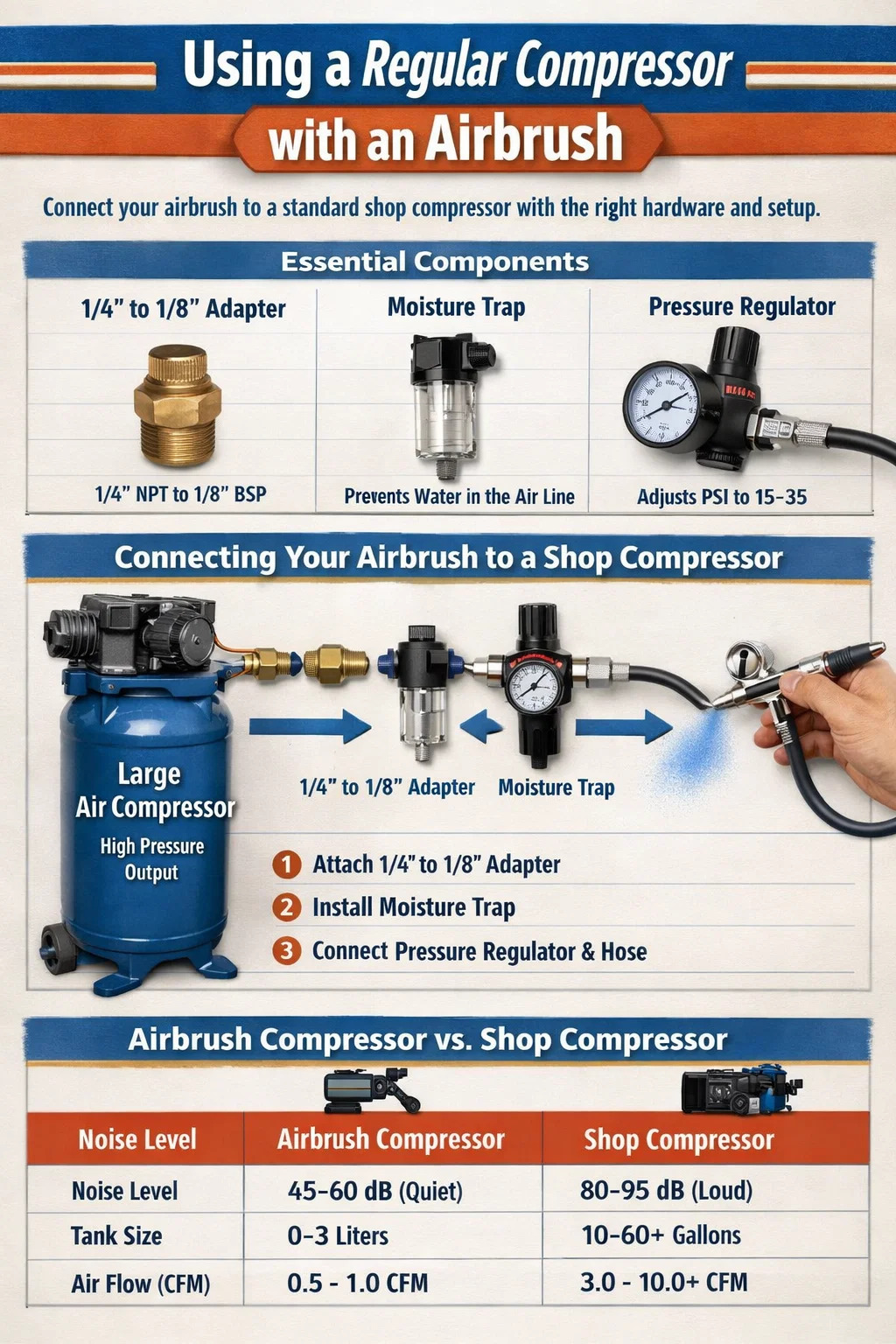
Standard shop compressors usually feature 1/4-inch NPT (National Pipe Thread) fittings, whereas the typical airbrush hose uses a much smaller 1/8-inch BSP (British Standard Pipe) threading. To bridge this gap, you must utilize specific conversion hardware.
- Reducers and Adapters: A simple brass adapter (1/4" male to 1/8" male) is the most common solution to connect a standard airbrush hose to a large compressor manifold.
- Moisture Traps: Large compressors pull in significant amounts of ambient humidity. Without an in-line moisture trap, water will condense in the tank and shoot through your airbrush, causing your paint to "splatter" or bubble on the surface.
- Fine-Tune Regulator: Most shop compressors are built to run tools at 90 PSI or higher. Since airbrushing typically happens between 15 and 35 PSI, you need a high-quality regulator that can accurately hold these lower pressures.
Comparing Airbrush Compressors vs. Regular Shop Compressors
Before you commit to using your garage unit for fine art or model painting, consider the trade-offs in performance, noise, and air quality.
| Feature | Dedicated Airbrush Compressor | Regular Shop Compressor |
|---|---|---|
| Noise Level | Quiet (45-60 dB) | Loud (80-95 dB) |
| Tank Capacity | Zero to 3 Liters | 10 to 60+ Gallons |
| Portability | High (Hand-carried) | Low (Stationary or wheeled) |
| Air Flow (CFM) | 0.5 - 1.0 CFM | 3.0 - 10.0+ CFM |
Pressure Regulation and Safety Considerations
The biggest risk of using a regular compressor is the sheer amount of pressure it can generate. Most airbrush hoses are only rated for up to 50 or 60 PSI. If your shop compressor is set to its maximum output (often 125-150 PSI), you risk bursting the airbrush hose or damaging the delicate internal seals of the airbrush itself.
Always follow this startup routine:
- Turn the compressor regulator dial all the way down to zero before connecting your airbrush.
- Gradually increase the pressure while holding down the airbrush trigger until you reach the desired working pressure.
- Double-check that your moisture trap is empty; large tanks collect water quickly, and a "wet" blast can ruin hours of painting work.
Dealing with Noise and Air Quality
The main drawback of a regular compressor is the noise. If you are airbrushing in a small room or apartment, the loud kick-on of a 5-gallon shop compressor can be jarring. However, because these compressors have large tanks, you can often fill the tank once and then turn the motor off, allowing you to airbrush in total silence for 20 to 30 minutes using only the stored air.
Another factor is "oil-free" vs. "oil-lubricated" compressors. If you use an oil-lubricated regular compressor, you must use an oil filter in addition to a moisture trap. Tiny droplets of oil in the air line will cause "fish-eyes" in your paint, where the color refuses to stick to the surface, creating small, circular gaps in your finish.
Summary of Steps to Connect Your Airbrush
If you have a regular compressor ready to go, follow this checklist to begin airbrushing safely:
- Install a 1/4" NPT to 1/8" BSP adapter on the compressor outlet.
- Attach a dedicated airbrush regulator if the compressor's built-in one is too coarse.
- Add a moisture trap as close to the airbrush as possible.
- Drain the tank after every session to prevent internal rust and water buildup.
By using a regular compressor, you gain the benefit of unlimited air supply and consistent pressure, making it a construction-grade solution for a delicate artistic process.