 English
 русский
Sep 21,2026
Content
You can use regular paints, but you absolutely cannot pour them directly into the airbrush.
The nozzle of an airbrush is extremely fine, even thinner than a needle tip. If you put regular paints used for painting walls, watercolors, or acrylics directly into it, there's only one result: it will clog immediately.
If you want to use your regular paints for airbrushing, you must pay attention to the following key points:
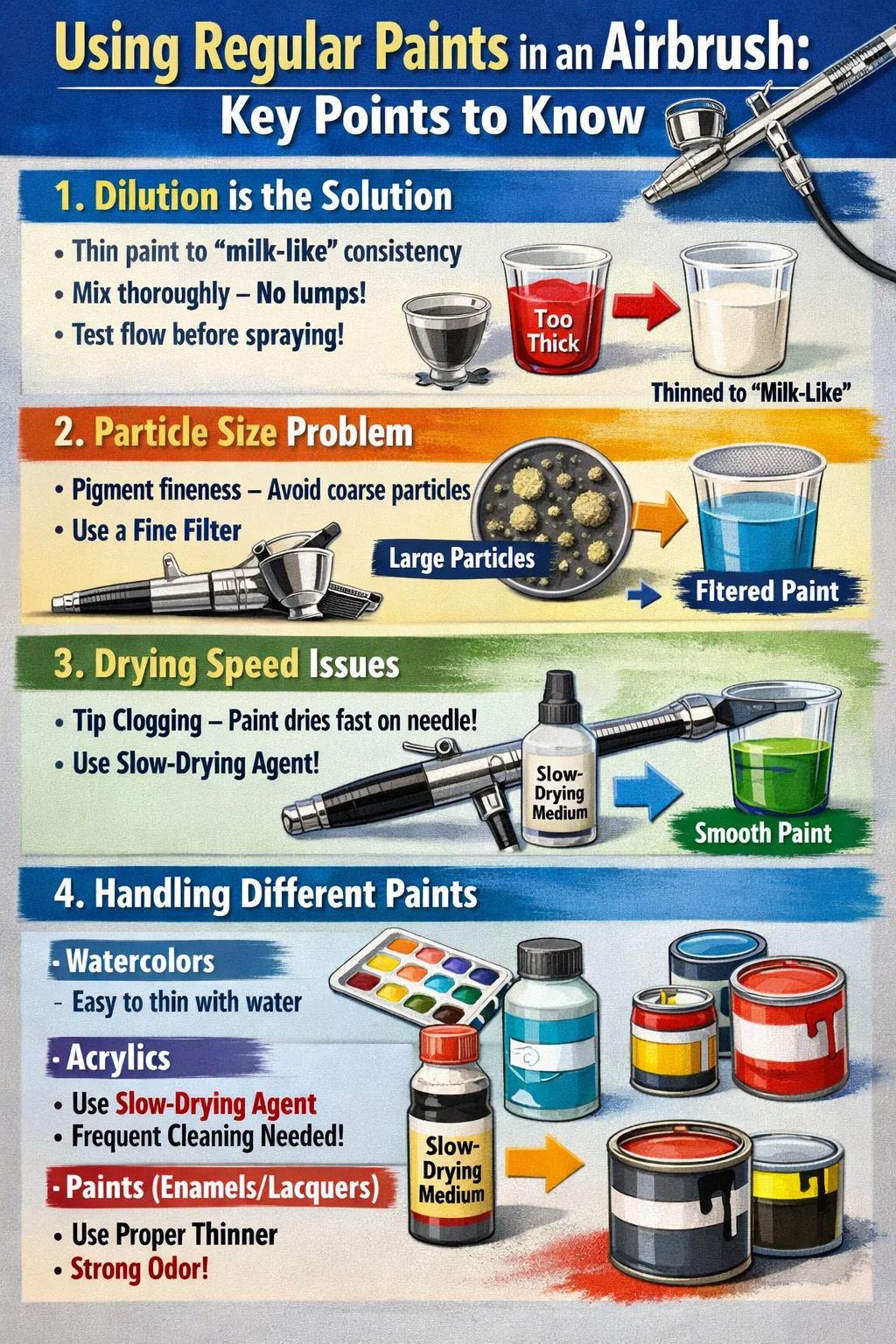
1. Dilution is the only solution
Regular paints are too thick, like paste, and an airbrush simply can't spray them.
Like milk: You need to add a special thinner (or water or alcohol depending on the paint type) to thin the paint to a consistency like cold milk. If it doesn't cling to the side of the cup and drips down quickly, then you can try spraying it.
Solubility: Ensure the paint and thinner are completely mixed, without any lumps.
2. The challenge of particle size
This is the most easily overlooked problem.
Pigment fineness: Specialized airbrush paints are manufactured with very, very fine pigments. Some inexpensive regular paints have coarse particles like "small stones," and even if you dilute them heavily, these particles will still clog the nozzle.
Filtering: If you absolutely must use regular acrylics or paints, it's recommended to filter them with fine nylon stockings or a special filter before pouring them into the airbrush to remove any invisible debris.
3. The trouble with drying speed
Regular paints (especially regular acrylics) dry very quickly.
Tip clogging: During spraying, the airflow accelerates paint drying. Regular paints easily form hard clumps on the airbrush needle tip, causing the sprayed color to be intermittent or even stop completely.
Cleaning difficulty: Once regular paint dries inside the airbrush, cleaning it will be a major headache.
4. Handling different types of paint
Watercolors: Relatively easy to use because the particles are fine and completely soluble in water; you only need to control the consistency.
Acrylics: The most commonly used but also the most prone to clogging. You must use a special "slow-drying agent," otherwise you'll have to clean the brush every two minutes. Paints: These require the use of corresponding chemical thinners, have a strong odor, and also place certain demands on the seals inside the airbrush.