 English
 русский
Oct 05,2026
Content
In most cases, you must dilute the paint.
Even paints labeled "Airbrush Ready" often require slight adjustments based on the day's temperature, air pressure, and the desired effect.
Here are the detailed reasons why you need to dilute the paint and how to do it:
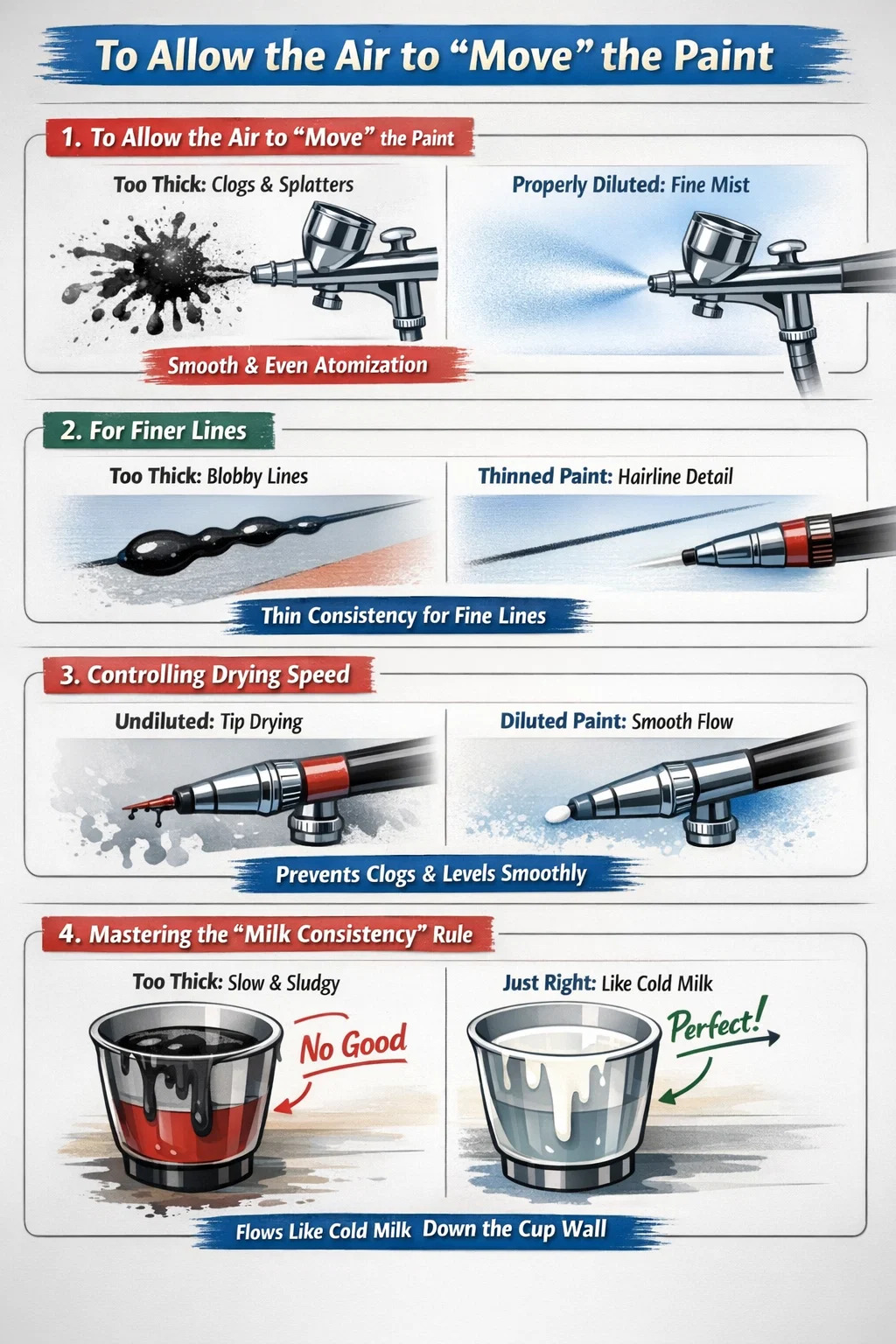
1. To allow the air to "move" the paint
Airbrushes work by using high-speed airflow to "break down" the paint into tiny particles.
Physical limitations: If the paint is too thick, like thick porridge, the airflow won't be able to atomize it. The paint will clog the nozzle or spray out in large blobs like "spitting."
Smoothness: Only when diluted to the right consistency can the airbrush produce a fine, smoke-like effect, rather than a discontinuous, grainy texture.
2. For finer lines
If you want to paint hair-thin lines with an airbrush, dilution becomes especially important.
Low-pressure spraying: Painting fine lines requires lowering the air pressure of the air compressor. To get paint to flow at very low pressure, the paint must be diluted to a very thin consistency (like colored water).
Preventing buildup: Diluted paint sprays onto the object in a thin layer, allowing you to layer colors multiple times while maintaining a smooth surface without thick paint buildup.
3. Controlling drying speed
When airbrushing, the air carries away a large amount of water or solvent from the paint.
Preventing "tip drying": If not diluted, the paint often dries on the needle tip before it even reaches the object's surface. This causes the airbrush to clog more and more.
Leveling: Moderate dilution allows the paint to flow for a moment after landing on the object's surface, automatically "leveling" itself to form a smooth, mirror-like coating.
4. Mastering the "milk consistency" rule
The most common standard for beginners to determine if the paint is properly diluted is to observe its flow.
Observe the cup wall: After mixing the paint in the airbrush's paint cup, observe how quickly it flows down the cup wall. If it flows like cold milk, leaving behind a translucent film after it passes, then it's just right.
Multiple experiments are necessary: Different colors (for example, white is usually thicker than black) require different dilution ratios, which you'll need to figure out through practice.