 English
 русский
Sep 21,2026
Content
- 1 The Short Answer: Airbrush-Specific Acrylic Paint Is the Best Starting Point
- 2 Why Paint Type Matters More Than the Color Itself
- 3 Which Color Hues Are Hardest to Spray — and Why
- 4 Top Airbrush Paint Brands and Their Best Color Ranges
- 5 How to Choose the Right Color for Your Specific Airbrush Application
- 6 Thinning Ratios: Getting Any Color to Spray Properly
- 7 Metallic and Special-Effect Colors: What to Expect
- 8 Air Pressure Settings and How They Interact with Color Choices
- 9 Essential Colors Every Airbrush Artist Should Have
- 10 Common Mistakes When Choosing and Using Airbrush Colors
- 11 Final Recommendations: Matching Color to Your Airbrush Setup
The Short Answer: Airbrush-Specific Acrylic Paint Is the Best Starting Point
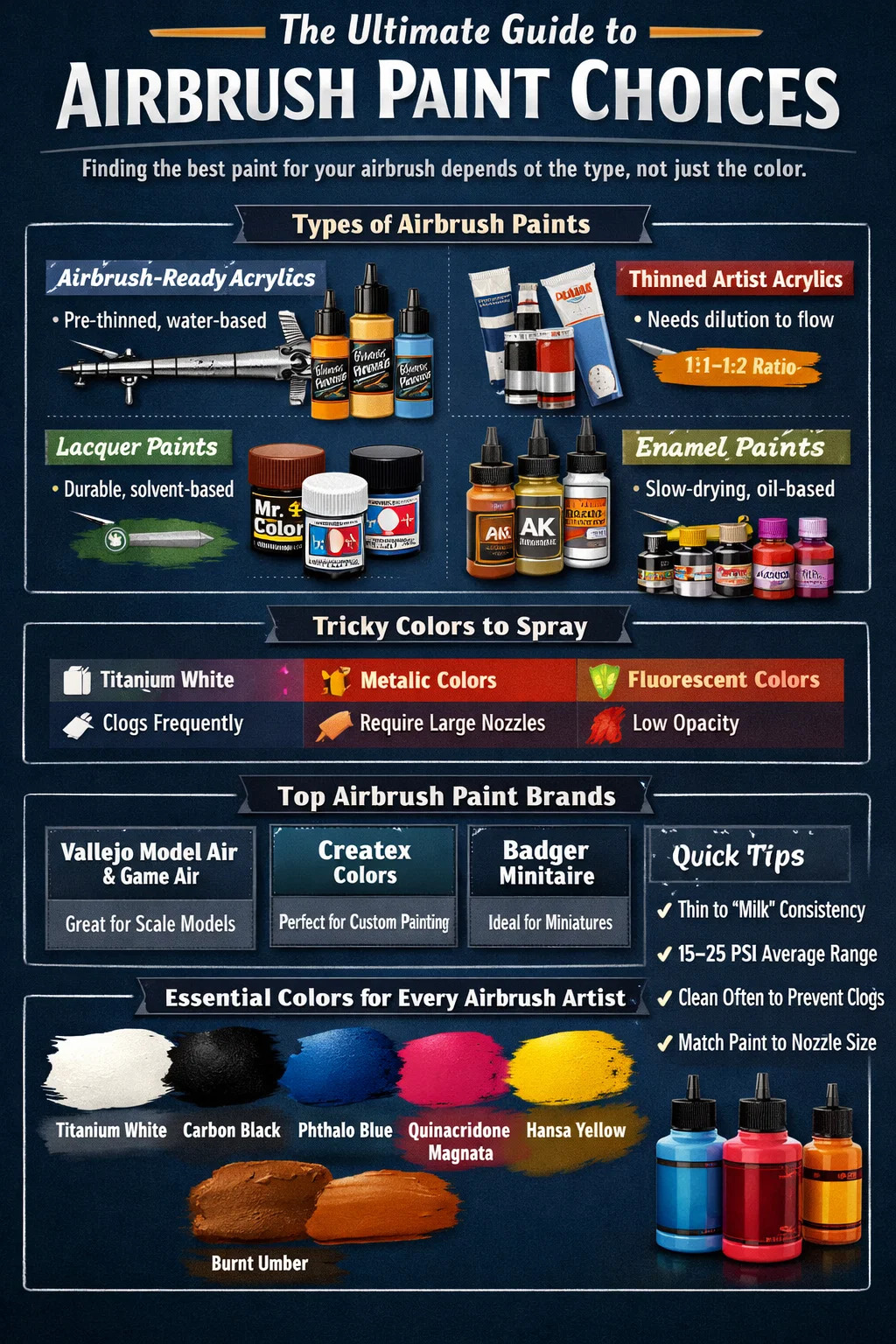
If you want a direct answer without any detours — airbrush-ready acrylic paints are the best all-around choice for most airbrush users, whether you're painting scale models, custom sneakers, cake art, body painting, or fine art canvases. They are water-based, non-toxic, fast-drying, and formulated with fine enough pigment particles to flow through airbrush nozzles without clogging. Brands like Vallejo, Createx, and Badger Minitaire lead this category for good reason.
That said, "best color" means two different things depending on your question. If you're asking about the type of paint or color medium — acrylics win. If you're asking about which hues or shades work best through an airbrush — that depends on pigment load, particle size, and how the color is formulated. Both answers are covered in depth below.
Why Paint Type Matters More Than the Color Itself
Before diving into specific hues, it's important to understand that an airbrush doesn't distinguish between red and blue — it distinguishes between paint that flows and paint that clogs. The medium (the type of paint) is the biggest factor in airbrush performance. Here's a breakdown of the main categories:
Airbrush-Ready Acrylic Paints
These are pre-thinned, low-viscosity acrylics designed specifically for airbrush use. They typically have a viscosity of around 20–40 centipoise (cP), which is close to the consistency of skim milk — exactly what most airbrushes need. Brands in this category include Vallejo Model Air, Createx Illustration Colors, and Harder & Steenbeck Infinity. Most can be sprayed straight from the bottle through a 0.3mm or 0.4mm nozzle without any additional thinning.
Standard Artist Acrylics (Thinned Down)
Heavy-body or even fluid acrylics from brands like Golden, Liquitex, or Winsor & Newton can work in an airbrush, but they must be thinned. A typical ratio is 1 part paint to 1–2 parts airbrush medium or distilled water. The risk with standard acrylics is inconsistent pigment grind — some colors, especially certain whites and yellows, contain larger pigment particles that block nozzles.
Lacquer-Based Airbrush Paints
Lacquers like Mr. Color (GSI Creos) and Tamiya Lacquer deliver exceptional durability and a glass-smooth finish. They're favored in scale modeling and automotive custom work. However, they require solvent-based thinners, good ventilation, and a respirator. Lacquers dry in as little as 10–15 minutes and are highly resistant to chipping, but they're not beginner-friendly.
Enamel Airbrush Paints
Enamels like Humbrol and AK Interactive Enamel are slow-drying (sometimes taking 24 hours to fully cure) and oil-based. They blend beautifully and self-level well, which gives smooth gradients. But cleanup requires mineral spirits or enamel thinners, and they're less forgiving for beginners. They're popular for weathering effects on scale models.
Watercolors and Inks
Liquid watercolors and dye-based inks (like Dr. Ph. Martin's Hydrus or Com-Art Transparent) are extremely fluid and pass through airbrushes with almost no resistance. They're ideal for illustration, textile work, and fine art. The downside is that they're not as lightfast as acrylics and won't adhere to non-porous surfaces without a binder.
Which Color Hues Are Hardest to Spray — and Why
Not all colors behave the same through an airbrush, even within the same brand and paint line. This comes down to pigment chemistry. Some pigments are naturally larger in particle size or require higher pigment loads to achieve opacity, which makes them more prone to tip-dry, clogging, and uneven spray patterns.
| Color / Pigment Type | Spray Behavior | Common Issues | Tips |
|---|---|---|---|
| Titanium White | Difficult | Clogs frequently, tip-dry | Thin to 1:2, clean often |
| Cadmium Yellow / Orange | Moderate | Inconsistent particle size | Use hue alternatives |
| Transparent/Glazing Colors | Excellent | Very few | Use for gradients and glazing |
| Metallic / Pearl Colors | Tricky | Mica particles clog fine nozzles | Use 0.5mm+ nozzle |
| Phthalo Blue / Green | Easy | Staining of airbrush parts | Flush thoroughly after use |
| Burnt Umber / Raw Sienna | Good | Minimal | Works well thinly diluted |
| Fluorescent Colors | Easy to Moderate | Low opacity, need multiple passes | Layer over white base |
Transparent and semi-transparent colors consistently perform best through an airbrush because they use dye-like or finely ground pigments at low concentrations. Opaque colors — especially whites, bright yellows, and metallic shades — are the most demanding.
Top Airbrush Paint Brands and Their Best Color Ranges
The brand you choose matters enormously. Not every paint line is equally suitable for airbrushing, and even within a great brand, some color series outperform others. Here's what the top options actually offer:
Vallejo Model Air and Game Air
Vallejo is widely considered the gold standard for hobby and scale model airbrushing. Their Model Air range has over 200 colors specifically tuned for airbrush use. Vallejo paints have an average pigment particle size of under 10 microns, making them suitable for 0.2mm nozzles without straining. The Game Air line is equally refined, with brighter, more saturated tones designed for miniature painting. Colors like Vallejo Air Intermediate Blue, Pale Blue, and White Grey are consistently praised for smooth coverage and minimal tip-dry.
Createx Colors
Createx is the dominant name in textile and custom automotive airbrushing. Their Illustration Colors and Wicked Colors lines are extremely popular among T-shirt artists, custom car painters, and body artists. Createx Wicked Colors are certified non-toxic and intermixable, giving users a palette of over 80 colors that can be combined freely. The transparent series — including Transparent Magenta, Yellow, and Cyan — are especially valued for color layering and photorealistic effects.
Badger Minitaire and Ghost Tints
Badger's Minitaire line is made specifically for miniature painters and flows effortlessly through 0.2–0.3mm nozzles. The Ghost Tints series — translucent jewel-toned colors — layer over metallic or white basecoats to create vivid, glowing effects without any clogging issues. These are among the easiest airbrush colors to work with for beginners.
Tamiya Acrylic and Lacquer Series
Tamiya's acrylic line is lighter and thinner than most hobby acrylics, making it a reliable choice for panel painting and automotive detail work. The lacquer series offers superior durability but requires X-20 thinner or lacquer thinner. Tamiya's flat and semi-gloss colors are particularly noted for consistent spray patterns, even through narrow 0.3mm nozzles. The Smoke and Clear colors are favorites for canopy effects on aircraft models.
Golden High Flow Acrylics
Golden's High Flow line brings fine-art quality into the airbrush world. These are ink-like acrylics with the color quality and lightfastness ratings of professional artist paints. Many Golden High Flow colors carry ASTM I or II lightfastness ratings, making them a top choice for artists who need long-lasting results on canvas or paper. The Quinacridone Magenta, Phthalo Blue, and Carbon Black in this line are exceptionally clean sprayers.
How to Choose the Right Color for Your Specific Airbrush Application
The "best" airbrush color genuinely depends on what you're doing with your airbrush. A color that's perfect for scale modeling might be completely wrong for cake decorating or fabric painting. Here's a practical breakdown by application:
Scale Models and Miniatures
- Best choice: Vallejo Model Air, Tamiya Acrylic, AK Interactive RC Colors
- Key colors: Realistic military shades (Olive Drab, Dunkelgelb, RAF Blue-Grey), metallic grays
- Nozzle size: 0.2–0.3mm works well for detail; 0.4mm for base coating
- Avoid: Standard heavy-body acrylics without thinning; metallics through 0.2mm nozzles
Custom Footwear and Leather
- Best choice: Angelus Leather Paint (airbrush formula), Createx Wicked Colors
- Key colors: Opaque primaries and blacks for base coats; pearl and metallic for accent work
- Important: Thin Angelus 2:1 with their 2-Thin reducer for airbrush use
- Always seal with a finisher (matte or gloss) to prevent cracking
Body Painting and Makeup
- Best choice: Dinair Airbrush Makeup, Temptu Pro, Mehron Paradise Airbrush
- These are water-activated or alcohol-based and FDA-compliant for skin contact
- Skin-tone shades (beige, sand, tan) are the highest-demand colors in this category
- Never use standard acrylic or lacquer paints on skin — serious health risk
Cake and Food Decoration
- Best choice: Chefmaster Airbrush Food Color, Americolor Airbrush Color
- All colors must be food-safe and certified for edible use
- Gel-based food colors need to be diluted with food-safe ethyl alcohol or water before airbrushing
- Popular choices: Red, black, and gold for dramatic cake effects; pastel blends for wedding cakes
Fine Art and Illustration
- Best choice: Golden High Flow, Holbein Aeroflash, Dr. Ph. Martin's Hydrus
- Prioritize lightfastness (ASTM I–II) for archival work
- Transparent color layers (glazes) give photorealistic gradients impossible with brushwork
- Ink-consistency liquids like Holbein Aeroflash can be sprayed through 0.15mm nozzles
Thinning Ratios: Getting Any Color to Spray Properly
Even the best airbrush color will fail if mixed at the wrong viscosity. The classic test is the "milk test" — your thinned paint should flow and drip like skim milk, not like cream or water. Here are reliable thinning ratios for the most common paint types:
| Paint Type | Thinner to Use | Starting Ratio (Paint:Thinner) | Notes |
|---|---|---|---|
| Airbrush-ready acrylics | None / distilled water | Ready to use / up to 1:0.5 | Add water only if tip-dry occurs |
| Heavy-body acrylics | Airbrush medium or distilled water | 1:1 to 1:2 | Medium preserves binder better than water |
| Lacquers | Lacquer thinner or brand-specific (e.g., Tamiya X-20) | 1:1 to 2:1 | Use in ventilated space with respirator |
| Enamels | Enamel thinner / white spirit | 1:1 to 1:1.5 | Slow drying — good for blending |
| Food-safe airbrush colors | Vodka or food-grade alcohol / water | 1:0.5 to 1:1 | Test on fondant or white icing first |
Never thin acrylics with more than 30% water by volume unless you're using a dedicated airbrush medium. Excessive water breaks down the acrylic binder, leading to poor adhesion, cracking, and a chalky finish once dry.
Metallic and Special-Effect Colors: What to Expect
Metallic, pearl, and iridescent airbrush colors are among the most sought-after — and most misunderstood. The shimmer in these paints comes from mica flakes or aluminum particles, which are significantly larger than regular pigment particles. Most metallic airbrush paints require a nozzle of at least 0.4mm — ideally 0.5mm or larger — to prevent the metallic particles from clogging the tip.
Some well-regarded metallic airbrush colors include:
- Createx 5600 Candy2o Series — translucent candy colors over silver base; vivid automotive effects
- Vallejo Metal Color — very fine metallic particles, can be sprayed through 0.3mm with care
- Badger Ghost Tints (metallics) — designed for 0.3mm nozzle compatibility with miniature airbrushes
- Mr. Color Super Metallic — mirror-like chrome effects; lacquer-based, requires solvent thinner
For convincing chrome effects, the technique matters as much as the paint. A polished black gloss base followed by Alclad II Chrome (a lacquer-based metallic) over a 0.4mm nozzle at 15–18 PSI produces near-mirror finishes on scale models.
Air Pressure Settings and How They Interact with Color Choices
Color performance through an airbrush isn't just about the paint — it's a triangle of paint consistency, nozzle size, and air pressure. Most acrylic airbrush colors perform best at 15–25 PSI, but this varies significantly by application:
- Fine detail work (miniatures, illustration): 10–15 PSI with a 0.2–0.3mm nozzle
- Base coating large surfaces: 20–30 PSI with a 0.4–0.5mm nozzle
- Textile and T-shirt painting: 30–45 PSI to push paint into fabric fibers
- Food decoration: 10–20 PSI to avoid disturbing fondant or royal icing surfaces
Higher pressure doesn't always mean better coverage. Too much PSI causes paint to dry mid-air before it hits the surface (overspray), orange-peel texture, or paint bouncing off the surface rather than adhering. When white or opaque colors spatter unexpectedly, lowering pressure by 5 PSI and thinning the paint slightly usually solves the problem.
Essential Colors Every Airbrush Artist Should Have
Whether you're just getting started or refining your palette, certain colors are foundational. A well-chosen core set lets you mix virtually any shade while minimizing waste and unnecessary clutter. Here's what experienced airbrush artists consistently recommend as essentials:
The Core Six for Beginners
- Titanium White — for highlights, tinting, and opacity building; choose an airbrush-formula version
- Carbon Black or Lamp Black — for shading, dark tones, and glazing; the most versatile dark
- Phthalo Blue (Green Shade) — the most powerful cool blue; mixes clean greens and purples
- Quinacridone Magenta or Red — a strong, transparent warm red; essential for warm purples and skin tones
- Hansa Yellow Medium — a clean, transparent yellow that mixes reliable greens and oranges
- Burnt Umber — a natural earth tone for portraits, textures, and shadow glazing
From these six colors, you can theoretically mix any shade you need. In practice, adding a few convenience colors — like a ready-mixed skin tone, a military green, or a specific fluorescent — saves time and ensures consistency across a project.
Colors Worth Adding as Your Skills Grow
- Transparent Red Oxide — for realistic rust, woodgrain, and warm shadow effects
- Payne's Grey — a versatile desaturated blue-grey for shadows without using pure black
- Fluorescent Orange — for blaze orange, sunset effects, and safety markings
- Metallic Silver (fine grade) — for chrome accents and metallic gradients
- Transparent UV Fluorescent — for blacklight effects and hidden design work
Common Mistakes When Choosing and Using Airbrush Colors
Even experienced users run into predictable problems when selecting or using airbrush colors. Recognizing these issues early saves time, money, and frustration:
- Using craft store acrylics (e.g., Apple Barrel, DecoArt) unthinned: These are formulated for brush application and have large pigment particles. They clog 0.3mm and smaller nozzles almost immediately. If you must use them, thin heavily (1:2) and strain through a nylon stocking.
- Mixing incompatible mediums: Never mix lacquer with acrylic or acrylic with enamel without testing first. Chemical reactions can cause the paint to curdle, gel, or refuse to dry.
- Ignoring tip-dry as a color-specific warning: If one color constantly dries at the tip and others don't, the formula of that specific color is the issue — not your technique or pressure. Switch brands for that hue or add a drop of retarder.
- Storing mixed colors in a sealed cup: Thinned acrylics deteriorate quickly. Mix only what you need for each session and discard leftover thinned paint. Pre-mixed bottles sealed properly can last a few days at most.
- Skipping a primer or base coat: Transparent colors look entirely different on raw white, black, or grey surfaces. A consistent, sealed primer coat ensures predictable color results, especially for opaque coverage.
Final Recommendations: Matching Color to Your Airbrush Setup
Choosing the best color for your airbrush ultimately comes down to pairing the right paint system with your nozzle size, compressor output, and intended surface. As a general guide:
- If you have a 0.2–0.3mm nozzle: Use Vallejo Air, Badger Minitaire, or Golden High Flow. Avoid metallics and heavy whites without heavy thinning.
- If you have a 0.4–0.5mm nozzle: You have much more flexibility. Createx, Tamiya, lacquers, and metallic colors all work reliably.
- If you're a beginner: Start with Vallejo Game Air or Badger Minitaire — they are the most forgiving and clog the least.
- If you're working on fabric or leather: Createx Wicked or Angelus Leather Paint are purpose-built and far more durable than general acrylics.
- If you need archival quality for fine art: Golden High Flow with their professional-grade pigments and lightfastness ratings is the clear choice.
The best airbrush color is the one that flows cleanly through your setup, adheres to your surface, and achieves the effect you're after — and that answer is different for every artist, every project, and every airbrush. Understanding the principles behind pigment size, viscosity, and paint chemistry puts you in a position to make that judgment with confidence every time.